I've always been fascinated by the fact that every human brain is unique. Among the 8.1 billion people alive on Earth, no two people share the same brain anatomy - every brain is wired differently (9). Despite all our common traits, we each have distinct thoughts, perceptions, and experiences of life - we have different realities. Essentially, every mind is its own universe. I often ponder this metaphor as I observe and interact with people through daily life.
Not too long ago, I stumbled upon an interesting analogy in the book The Big Picture by Sean Carroll, where he draws a parallel between our brains and the universe, comparing the physical structures, thermodynamics, and processes in both entities. This brought me right back to the metaphor I love. Could it be that every mind is actually its own universe?
The Parallel Between Your Brain and the Universe
I browsed through existing literature to explore these parallels, looking to understand the extent of these similarities and whether they could somehow offer an explanation for the intense, moving feeling I get when gazing into the starry night sky. Furthermore, I wanted to uncover potential lessons this intriguing parallel could teach us about our lives.
I first came across a study by Franco Vazza, an astrophysicist at the University of Bologna, and Alberto Feletti, a neurosurgeon at the University of Verona, who combined their disciplines to conduct a quantitative analysis of the brain and the universe. They found striking similarities in the structure and processes of both entities, despite differences in scale. I further explored papers about brain circuit connectivity and activity, cognition, and the cosmic web, along with blog posts and interactive art installations exploring the connection between the cosmos and the mind — all referenced below.
I discovered profound parallels between the brain and the universe, that offer lessons directly applicable to our lives. These parallels not only put things into perspective, but inspire self-actualization, and teach us about transcending our limits.
How is Your Brain Similar to the Universe?
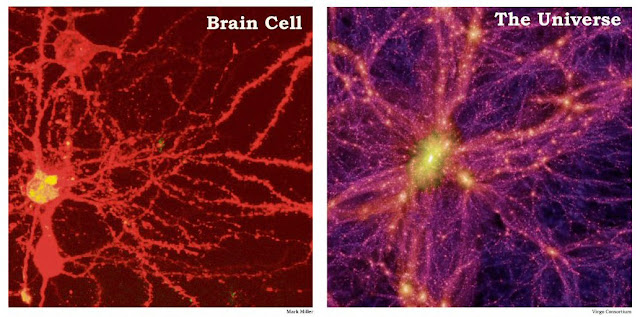 Left: a neuron and its connections (Mark Miller, Brandeis University). Right: the large-scale structure of the universe (Virgo Consortium).
The images above exhibit two networks - a network of neurons within the human brain (left), and a cosmic network of galaxies comprising the universe (right). These are the most complex systems in nature, both beautiful and vast, yet still not fully understood. There are 4 main similarities that we can observe between the universe and the brain: physical structure, interconnectedness, limitless expansion, and energy dynamics.
Similarity #1: Physical Structure and Organization
There are about 100 billion galaxies in the universe, and 100 billion neurons in a human brain (10, 6). Both systems share the principle of self-organization. The arrangement of galaxies throughout the cosmos is comparable to the arrangement of neural networks in human brains. The composition of these systems is also noteworthy, with solid matter making up only 30% of each entity, while around 75% comprises passive elements - water in the brain and "dark energy" in the universe (10). When we sleep at night, our brains remain active as indicated by rhythmic brain waves, the same way the universe at rest remains active as gravitational waves ebb and flow in the quietest regions of space (7, 5).
The concept of voids; negative spaces that define the positive, play a pivotal role in both cosmic and neural realms, illustrating how the processes of growth, ageing, and decline affect both the universe and our brains. Voids, the emptiest regions in the universe, exert forces that push matter away over time. When these voids intersect, they give rise to the cosmic web and galaxies. Likewise, the web of neurons in our brains deteriorate with aging and disease, leading to empty spaces or voids as the brain atrophies (5). As the universe ages, cosmic voids become larger, reflecting the emptiness that develops within the brain as neurons deteriorate and as humans age.
Similarity #2: Interconnectedness
Looking at the images above, it's palpable how deeply interconnected both cosmic and neural networks are. This interconnectedness is observed in the way galaxies are clustered together in cosmic patterns, and in the neuronal networks through which our thoughts and ideas are transferred. Nodes in the brain and nodes in the cosmic web are each connected through intricate branching patterns. What makes these branching patterns intriguing is that they both scale similarly - in an arrangement that optimally connects all elements while minimizing total connection length (5). This scaling in both systems resembles a minimal spanning tree that points to efficiency in the establishment of connections in both systems (5). In the brain, this efficiency plays a role in effective information processing and communication between neurons.
It's this interconnectedness which allows for the linking between distinct areas of our brain associated with process-specific activities (1), such as how our amygdala, responsible for processing emotions, communicates with our frontal cortex, involved in decision-making and reasoning — enabling a seamless flow of information and contributing to the functioning of various brain regions. Particles become connected regardless of their distance from one another, as explained by quantum physics and the entanglement phenomenon. In the cosmos, regardless of physical distance, actions taken on one particle can instantly affect another.
Similarity #3: Limitless Expansion
The universe is constantly expanding over time. This is supported by the Big Bang Theory, and principles of general relativity. As a result, galaxies move further away from each other, with the rate of expansion increasing over time. The universe possesses the potential to form an almost infinite number of structures due to the dynamic interplay of gravitational forces and constant expansion (5).
Much like the limitless expansion observed in the universe, our brains and minds possess extraordinary potential for growth and transformation. Within neural networks, our brain cells hold the potential to form a nearly limitless number of connections (1). Interestingly, both the universe and the brain have achieved only a fraction of their potential (5, 6).
Similarity #4: Energy Dynamics
The universe and the brain are similar in the energy dynamics they exhibit related to growing, connecting, and transforming their structures. Both systems adhere to the concept of energy conservation. The first law of thermodynamics states that energy can neither be created nor destroyed. Galaxies emit energy through star formation, supernovae, and the interaction of black holes, while neural processes emit energy through synaptic transmission and ion channel operations. Energy transformation in galaxies refers to matter transmuting into energy through nuclear fusion, producing light and electromagnetic emissions. Within the brain, metabolic processes convert nutrients into energy.
The second law of thermodynamics states that the entropy of any isolated system can only increase (3). This is true in both the universe and our brains, where galaxies evolve towards states of higher disorder over time, and the brain experiences an increase in entropy with aging, marking the natural progression of both systems toward greater complexity.
Lessons to Learn from This Parallel
There are vital lessons we can take away from these parallels and apply directly to our lives to enrich our experiences, transcend our limits, and self-actualize.
Lesson #1: Change is the Only Constant in Life
Change is inevitable, in our lives, in our brains, and in the universe. It's something we must accept, and learn to thrive on. The universe is always moving, changing, rearranging its structure — similar to the neural networks in our brains. One underlying principle here is that energy cannot be created or destroyed, but transformed. Sometimes when you lose something in life, it may not seem like it but this loss might have paved the way for an unexpected gain in your life. Think about this the next time you get dumped in a relationship, or stress about the people closest to you changing.
Lesson #2: You Set the Limits of Your Potential
Your potential is limitless. Whatever limit exists to your potential is one that you, whether consciously or subconsciously, impose on yourself. You're standing in your own way. Try to become aware of these self-imposed limits you place on your potential, reflect on where they come from, and whether they are hindering you from achieving your full potential. The concept of limitless expansion, observed in both the universe and the brain, urges us to embrace our innate capacity for adaptation and perpetual growth.
Welcome new experiences, especially those outside of your comfort zone, as opportunities for expansion. Just as the universe continually evolves, approach life with curiosity, openness, and a belief in your capacity for continuous growth and improvement. Explore diverse interests, and maintain an open mind to the infinite possibilities that lie ahead.
Just as the universe and brain have only realized a fraction of their potential, consider that there may be untapped potential within yourself. There is infinite knowledge and information to learn about yourself and about the world around you. Learning makes your brain more powerful; your neural connections stronger, and more deeply intertwined. Engage in the discovery of yourself and of the world, and explore the depths of your abilities.
Lesson #3: There's Beauty in the Chaos
Life can get chaotic. Entropy, the degree of disorder and uncertainty, increases over time. This applies to the universe and our brains as they evolve and increase in complexity. It's in this very chaos that a unique and awe-inspiring beauty emerges, one that is easy to miss if we're deep in one of life's challenges. Embracing the beauty within disorder requires us to stay resilient as we face life's hurdles. Becoming aware that disorder is an inherent part of the cosmic and personal journey allows us to approach difficulties with a new perspective. Instead of viewing challenges as disruptive forces, recognize them as integral components of a grand, beautiful narrative - the unique story of your individual life. Each challenge represents a brushstroke that contributes to the larger canvas of your existence.
Lesson #4: Everything is Connected
I've saved the most important lesson for last. If you can take away one thing from this blog post, let it be this. The captivating interconnectedness in the brain and universe merely scratches the surface of the inherent interconnected nature of existence. Interconnectedness extends beyond these systems to encompass our ecosystem, human nature, and biological systems — permeating every aspect of our world. Everything is connected.
Acknowledging our interdependent reality encourages us to adopt a holistic approach to problem-solving. Solutions to complex issues often lie beyond the confines of a single discipline or perspective. Some of the world's biggest problems have been solved through analogous thinking; fueled by considering the interconnected nature of existence. For example, a doctor named Patrick Byrne noticed a similarity between the pattern of cell growth in the thyroid and the spread of wildfires. This analogy led to a breakthrough in understanding the growth patterns of thyroid cancer cells, illustrating how insights from one domain (ecology) could contribute to advancements in another (medicine). There are numerous examples of cases like these, ranging from the analogy of war games and business strategy, to the parallels of psychology and aviation safety (11).
Diverse perspectives and knowledge from different fields is evidently valuable in tackling challenges. This offers a paradigm shift that we can incorporate into our personal lives. By embracing a breadth of experiences and insights, and interacting with diverse people, we open ourselves to a richer understanding of our world, and enhance our problem-solving abilities.
In a world marked by complexity and interdependence, the value of interdisciplinary thinking guides us towards innovative solutions and a more profound appreciation for the interconnected nature of existence.
Conclusion
Throughout my research, I found that there are many parallels like this one, seen across structures in nature and our bodies - such as the striking similarity between the appearance and functionality of trees and lungs. While further research is needed to fully understand the implications of the parallels between the brain and the universe, the insights gained can certainly push you to transcend your limits and live a more fulfilled life.
All I could think about going through this research is the beauty of God's creation. The uniqueness of every individual brain translates to other aspects of ourselves. We all have unique looks, accents, and voices - yet there's a profound interconnectedness binding us to the universe and to one another.
References
- Battaglia, D., Witt, A., Wolf, F., & Geisel, T. (2012). Dynamic effective connectivity of Inter-Areal Brain Circuits. PLoS Computational Biology, 8(3). doi.org/10.1371/journal.pcbi.1002438
- Libeskind, N. I., van de Weygaert, R., Cautun, M., et al. (2017). Tracing the cosmic web. Monthly Notices of the Royal Astronomical Society, 473(1), 1195–1217. doi.org/10.1093/mnras/stx1976
- Collell, G., & Fauquet, J. (2015). Brain activity and cognition: a connection from thermodynamics and information theory. Frontiers in Psychology, 6, 818. doi.org/10.3389/fpsyg.2015.00818
- Lima, M. (2009). Brain + Universe. Visual Complexity Blog. visualcomplexity.com/vc/blog/?p=234
- Neyrinck, M., Elul, T., & Silver, M. (2020). Exploring Connections Between Cosmos & Mind Through Six Interactive Art Installations in "As Above As Below." SciArt Magazine. arxiv.org/pdf/2008.05942.pdf
- Pakkenberg, B., & Gundersen, H. J. (1997). Neocortical neuron number in humans: effect of sex and age. The Journal of Comparative Neurology, 384(2), 312–320.
- Schneider, P. (2015). Extragalactic Astronomy and Cosmology. doi.org/10.1007/978-3-642-54083-7
- NeuroGym Team (2022). Scientists: The human brain has odd similarities to the entire universe. NeuroGym Blog. blog.myneurogym.com
- Valizadeh, S. A., Liem, F., Mérillat, S., Hänggi, J., & Jäncke, L. (2018). Identification of individual subjects on the basis of their brain anatomical features. Scientific Reports, 8(1). doi.org/10.1038/s41598-018-23696-6
- Vazza, F., & Feletti, A. (2020). The quantitative comparison between the neuronal network and the cosmic web. Frontiers in Physics, 8. doi.org/10.3389/fphy.2020.525731
- Epstein, D. J. (2021). Range: Why Generalists Triumph in a Specialized World. Riverhead Books.